Architecture 05 - Galaxy Web Frameworks
Contributors

 John Chilton
Questions
How does Galaxy handle web requests?
What web frameworks does Galaxy use?
What is the difference between ASGI and WSGI?
Objectives
Understand the request/response cycle
Learn about ASGI, Starlette, and FastAPI
Understand WSGI and legacy routing
Learn about middleware layers
layout: introduction_slides topic_name: Galaxy Architecture
Architecture 05 - Galaxy Web Frameworks
The architecture of an interaction.
layout: true left-aligned class: left, middle — layout: true class: center, middle
class: reduce70
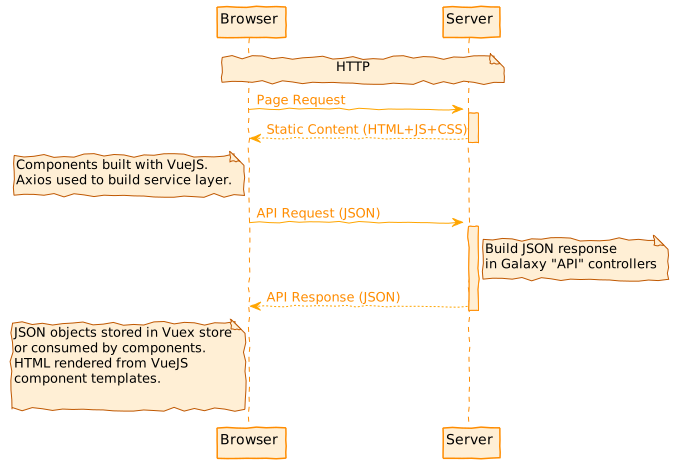
Bits and pieces of older client technologies appear throughout - ranging from Python mako templates to generate HTML, lower-level jQuery, Axios interactions, and Backbone legacy MVC.
class: center
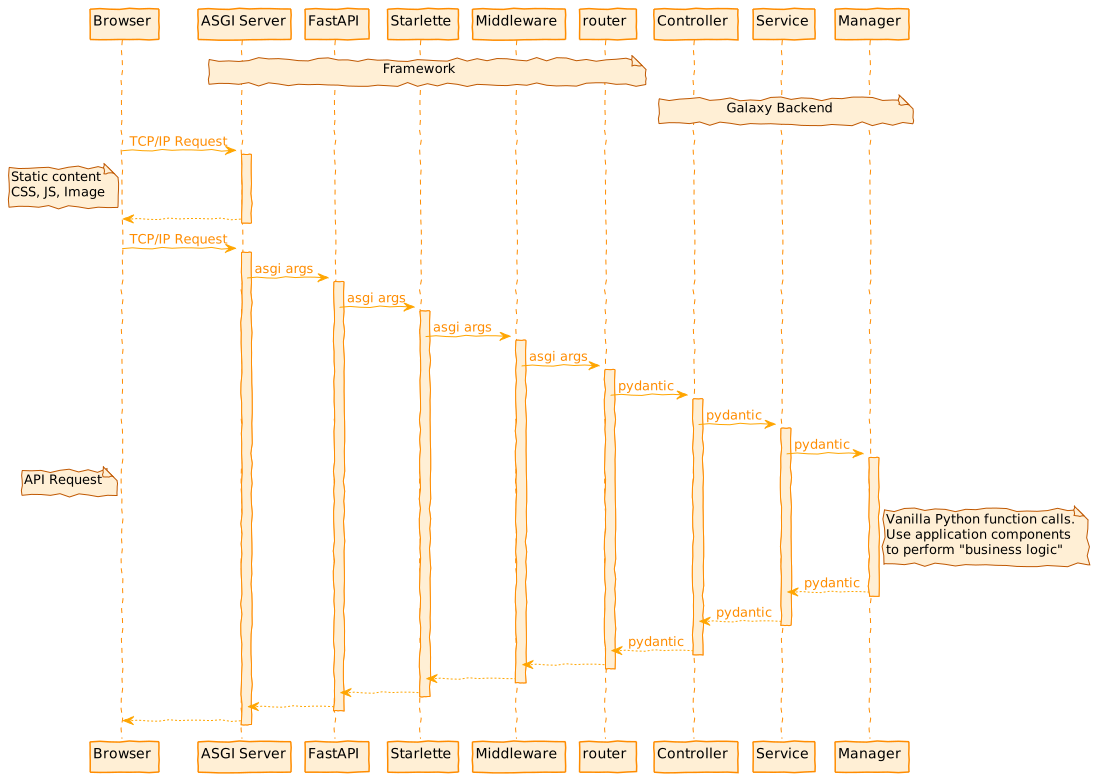
Expanding the right side of that diagram. We will move through the components left to right.
class: enlarge120
ASGI - Application
Spiritual successor to
WSGI. An ASGI application
is an async callable that takes in a scope (dict describing the
connection), send (an async callable to respond to events via),
and receive (an async callable to receive messages).
async def application(scope, receive, send):
    event = await receive()
    ...
    await send({"type": "http.response.body", ...})
Checkout ASGI documentation for more details.
ASGI & Starlette Low-level Example
We will talk a lot about Galaxy and FastAPI - but much of its plumbing is just aliases for starlette ASGI handling.
from starlette.responses import PlainTextResponse

async def app(scope, receive, send):
    assert scope['type'] == "http"
    response = PlainTextResponse('Hello, world!')
    await response(scope, receive, send)
If this is placed in a file called example.py with Starlette on
the Python path, the application server uvicorn can then host this
application with the following shell command:
$ uvicorn example:app
INFO: Started server process [11509]
INFO: Uvicorn running on http://127.0.0.1:8000 (Press CTRL+C to quit)
Example from starlette.io.
ASGI - Starlette High-level Example
Building a higher-level example.py with Starlette.
from starlette.applications import Starlette
from starlette.responses import JSONResponse
from starlette.routing import Route


async def homepage(request):
    return JSONResponse({'hello': 'world'})


app = Starlette(debug=True, routes=[
    Route('/', homepage),
])
A small framework for building web applications.
ASGI - FastAPI
From https://github.com/tiangolo/fastapi/blob/master/fastapi/applications.py
...
from starlette.applications import Starlette
...

class FastAPI(Starlette):
    ...
FastAPI (the library and the application base) extends starlette framework with features for building APIs. These include data validation, serialization, documentation generation.
class: center
FastAPI __call__
https://github.com/tiangolo/fastapi/blob/master/fastapi/applications.py
async def __call__(self, scope: Scope, receive: Receive, send: Send) -> None:
    if self.root_path:
        scope["root_path"] = self.root_path
    if AsyncExitStack:
        async with AsyncExitStack() as stack:
             scope["fastapi_astack"] = stack
             await super().__call__(scope, receive, send)
    else:
        await super().__call__(scope, receive, send)  # pragma: no cover
A light wrapper around Starlette’s call entry point.
Starlette __call__
https://github.com/encode/starlette/blob/master/starlette/applications.py
async def __call__(self, scope: Scope, receive: Receive, send: Send) -> None:
   scope["app"] = self
   await self.middleware_stack(scope, receive, send)
Walks through Starlette middleware.
Starlette build_middleware_stack
https://github.com/encode/starlette/blob/master/starlette/applications.py
def build_middleware_stack(self) -> ASGIApp:
    ...

    app = self.router
    for cls, options in reversed(middleware):
        app = cls(app=app, **options)
    return app
Start with the router and surround it with each layer of configured middleware.
class: enlarge150
ASGI Middleware
It is possible to have ASGI “middleware” - code that plays the role of both server and application, taking in a scope and the send/receive awaitable callables, potentially modifying them, and then calling an inner application.
https://asgi.readthedocs.io/en/latest/specs/main.html#middleware
class: enlarge150
Starlette Middleware
Starlette includes several middleware classes for adding behavior that is applied across your entire application. These are all implemented as standard ASGI middleware classes, and can be applied either to Starlette or to any other ASGI application.
https://www.starlette.io/middleware/
Starlette build_middleware_stack
https://github.com/encode/starlette/blob/master/starlette/applications.py
def build_middleware_stack(self) -> ASGIApp:
    ...

    app = self.router
    for cls, options in reversed(middleware):
        app = cls(app=app, **options)
    return app
Notice the inner most layer is the router.
FastAPI Router Initialization
https://github.com/tiangolo/fastapi/blob/master/fastapi/applications.py
class FastAPI(Starlette):
    def __init__(self, ...):
        self.router: routing.APIRouter = routing.APIRouter(
            routes=routes,
        )
FastAPI Router
from starlette import routing

class APIRouter(routing.Router):
   ...
Starlette Router
https://github.com/encode/starlette/blob/master/starlette/routing.py
async def __call__(self, scope: Scope, receive: Receive, send: Send) -> None:
   ...
   for route in self.routes:
       # Determine if any route matches the incoming scope,
       # and hand over to the matching route if found.
       match, child_scope = route.matches(scope)
       if match == Match.FULL:
           scope.update(child_scope)
           await route.handle(scope, receive, send)
           return
       ...
https://www.starlette.io/routing/
class: center
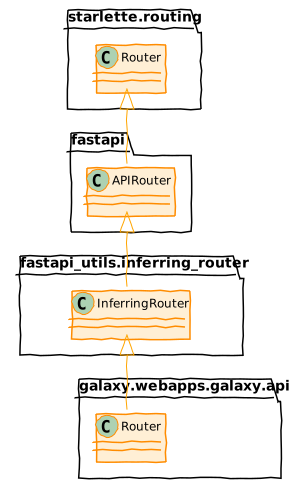
- https://www.starlette.io/routing/
- https://fastapi.tiangolo.com/tutorial/bigger-applications/#apirouter
- https://fastapi-utils.davidmontague.xyz/user-guide/inferring-router/
class: enlarge200
In order to understand how the routing classes are setup within Galaxy, lets step back and look really quickly at how Galaxy’s FastAPI application (ASGI endpoint) is constructed.
FastAPI Factory
lib/galaxy/webapps/galaxy/fast_factory.py
def factory():
    props = WebappSetupProps(
        app_name='galaxy',
        default_section_name=DEFAULT_CONFIG_SECTION,
        env_config_file='GALAXY_CONFIG_FILE',
        env_config_section='GALAXY_CONFIG_SECTION',
        check_galaxy_root=True
    )
    config_provider = WebappConfigResolver(props)
    config = config_provider.resolve_config()
    gx_webapp, gx_app = app_pair(
        global_conf=config.global_conf,
        load_app_kwds=config.load_app_kwds,
        wsgi_preflight=config.wsgi_preflight
    )
    return initialize_fast_app(gx_webapp, gx_app)
FastAPI Application
lib/galaxy/webapps/galaxy/fast_app.py
def initialize_fast_app(gx_webapp, gx_app):
    app = FastAPI(
        title="Galaxy API",
        docs_url="/api/docs",
        openapi_tags=api_tags_metadata,
    )
    add_exception_handler(app)
    add_galaxy_middleware(app, gx_app)
    add_request_id_middleware(app)
    include_all_package_routers(app, 'galaxy.webapps.galaxy.api')
    wsgi_handler = WSGIMiddleware(gx_webapp)
    app.mount('/', wsgi_handler)
    return app
Finding API Routers
Following this line:
include_all_package_routers(app, 'galaxy.webapps.galaxy.api')
to the file
lib/galaxy/webapps/base/api.py
def include_all_package_routers(app: FastAPI, package_name: str):
    for _, module in walk_controller_modules(package_name):
        router = getattr(module, "router", None)
        if router:
            app.include_router(router)
class: reduce70
Routing inside the Application
router = Router(tags=['tags'])


@router.cbv
class FastAPITags:
    manager: TagsManager = depends(TagsManager)

    @router.put(
        '/api/tags',
        summary="Apply a new set of tags to an item.",
        status_code=status.HTTP_204_NO_CONTENT,
    )
    def update(
        self,
        trans: ProvidesUserContext = DependsOnTrans,
        payload: ItemTagsPayload = Body(
            ...,  # Required
            title="Payload",
            description="Request body containing the item and the tags to be assigned.",
        ),
    ):
        """Replaces the tags associated with an item with the new ones specified in the payload.

        - The previous tags will be __deleted__.
        - If no tags are provided in the request body, the currently associated tags will also be __deleted__.
        """
        self.manager.update(trans, payload)
class: center
- https://www.starlette.io/routing/
- https://fastapi.tiangolo.com/tutorial/bigger-applications/#apirouter
- https://fastapi-utils.davidmontague.xyz/user-guide/inferring-router/
WSGI Fallback
Back to initialize_fast_app, two of the final lines were as follows:
wsgi_handler = WSGIMiddleware(gx_webapp)
app.mount('/', wsgi_handler)
This effectively provides a fallback to our legacy WSGI application.
WSGI
- Python interface for web servers defined by PEP 333 - https://www.python.org/dev/peps/pep-0333/.
- Galaxy tends to favor uWSGI, but other options such as Gunicorn and Paste can be used to host the application.
- https://uwsgi-docs.readthedocs.io/ (a million bells and whistles, highly performant, a bit brittle)
- https://gunicorn.org/ (simpler, more standard Python 3 WSGI server)
- https://bitbucket.org/ianb/paste (more of legacy interest, but still heavily used in testing for instance)
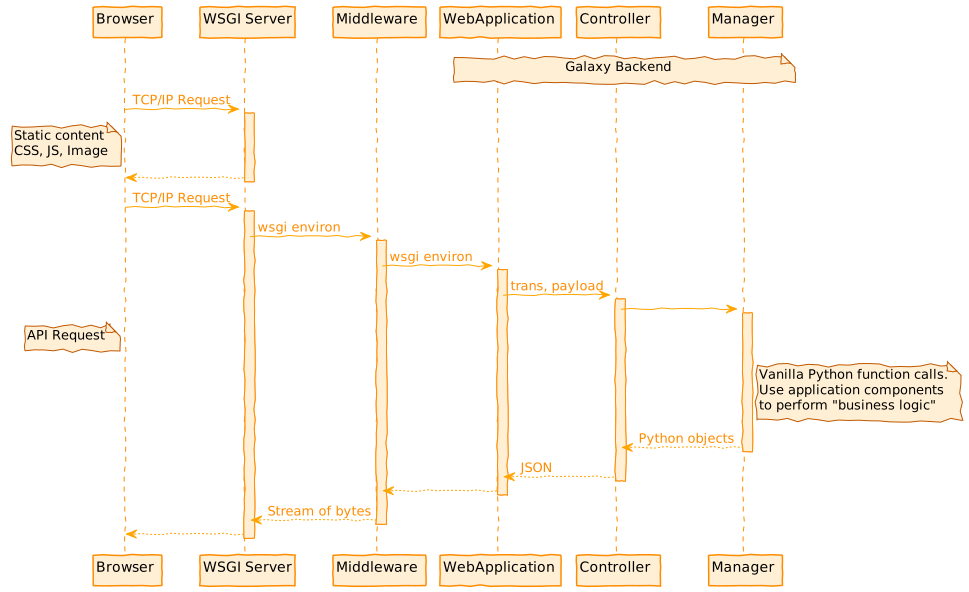
WSGI Middleware
A WSGI function:
def app(environ, start_response):
- Middleware act as filters, modify the
environand then pass through to the next webapp - Galaxy uses several middleware components defined in the
wrap_in_middlewarefunction ofgalaxy.webapps.galaxy.buildapp.
Galaxy’s WSGI Middleware
Middleware configured in galaxy.webapps.galaxy.buildapp#wrap_in_middleware.
paste.httpexceptions#make_middlewaregalaxy.web.framework.middleware.remoteuser#RemoteUser(if configured)paste.recursive#RecursiveMiddlewaregalaxy.web.framework.middleware.sentry#Sentry(if configured)- Various debugging middleware (linting, interactive exceptions, etc…)
galaxy.web.framework.middleware.statsd#StatsdMiddleware(if configured)galaxy.web.framework.middleware.xforwardedhost#XForwardedHostMiddlewaregalaxy.web.framework.middleware.request_id#RequestIDMiddleware
class: center
class: center
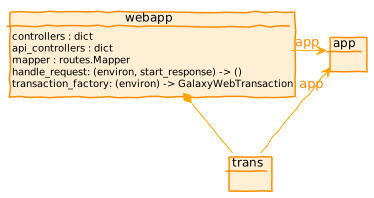
Instances
class: center
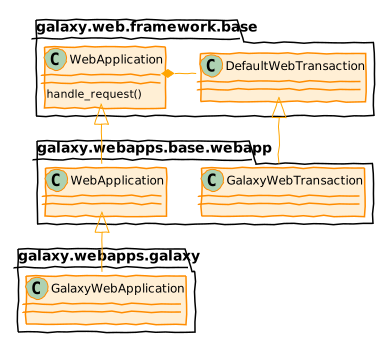
Classes
Routes
Setup on webapp in galaxy.webapps.galaxy.buildapp.py.
webapp.add_route(
    '/datasets/:dataset_id/display/{filename:.+?}',
    controller='dataset', action='display',
    dataset_id=None, filename=None
)
URL /datasets/278043/display matches this route, so handle_request will
- lookup the controller named “dataset”
- look for a method named “display” that is exposed
- call it, passing dataset_id and filename as keyword arg
Uses popular Routes library (https://pypi.python.org/pypi/Routes).
class: reduce70
Simplified handle_request from lib/galaxy/web/framework/base.py.
def handle_request(self, environ, start_response):
    path_info = environ.get( 'PATH_INFO', '' )
    map = self.mapper.match( path_info, environ )
    if path_info.startswith('/api'):
        controllers = self.api_controllers
    else:
        controllers = self.controllers

    trans = self.transaction_factory( environ )

    controller_name = map.pop( 'controller', None )
    controller = controllers.get( controller_name, None )

    # Resolve action method on controller
    action = map.pop( 'action', 'index' )
    method = getattr( controller, action, None )

    kwargs = trans.request.params.mixed()
    # Read controller arguments from mapper match
    kwargs.update( map )

    body = method( trans, **kwargs )
    # Body may be a file, string, etc... respond with it.
class: enlarge150
Controllers
Three varieties
- FastAPI ASGI API controllers
- WSGI API controllers
- Legacy WSGI web controllers.
Ideally each of these are thin. Focused on “web things” - adapting parameters and responses and move “business logic” to components not bound to web functionality.
class: enlarge150
FastAPI Controllers
- Found in
lib/galaxy/webapps/galaxy/controllers/api/. - Consume and produce typed data using Python 3 type annotations, FastAPI helpers, and Pydantic models.
- Router specifies HTTP verb (GET, POST, PUT, etc..) and how to parse path.
class: reduce70
FastAPI Controller Example
lib/galaxy/webapps/galaxy/controllers/api/roles.py
@router.cbv
class FastAPIRoles:
    role_manager: RoleManager = depends(RoleManager)

    @router.get('/api/roles')
    def index(self, trans: ProvidesUserContext = DependsOnTrans) -> RoleListModel:
        roles = self.role_manager.list_displayable_roles(trans)
        return RoleListModel(__root__=[role_to_model(trans, r) for r in roles])

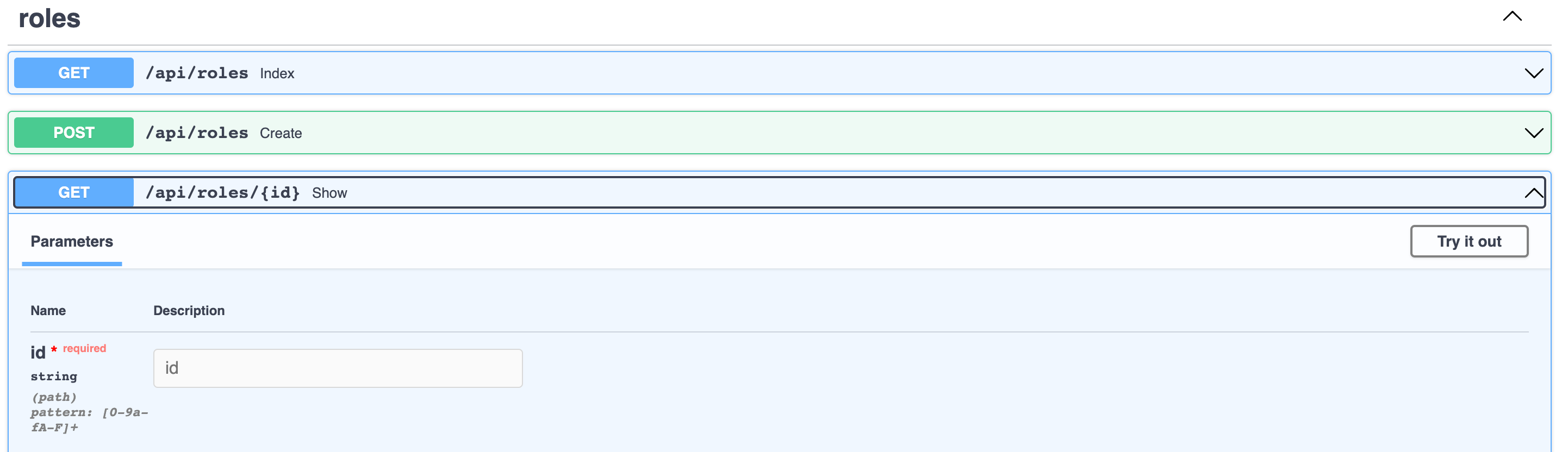
    @router.get('/api/roles/{id}')
    def show(self, id: EncodedDatabaseIdField, trans: ProvidesUserContext = DependsOnTrans) -> RoleModel:
        role_id = trans.app.security.decode_id(id)
        role = self.role_manager.get(trans, role_id)
        return role_to_model(trans, role)

    @router.post("/api/roles", require_admin=True)
    def create(self, trans: ProvidesUserContext = DependsOnTrans, role_definition_model: RoleDefinitionModel = Body(...)) -> RoleModel:
        role = self.role_manager.create_role(trans, role_definition_model)
        return role_to_model(trans, role)
class: reduce70
FastAPI and Pydantic
RoleIdField = Field(title="ID", description="Encoded ID of the role")
RoleNameField = Field(title="Name", description="Name of the role")
RoleDescriptionField = Field(title="Description", description="Description of the role")


class BasicRoleModel(BaseModel):
    id: EncodedDatabaseIdField = RoleIdField
    name: str = RoleNameField
    type: str = Field(title="Type", description="Type or category of the role")


class RoleModel(BasicRoleModel):
    description: str = RoleDescriptionField
    url: str = Field(title="URL", description="URL for the role")
    model_class: str = Field(title="Model class", description="Database model class (Role)")


class RoleDefinitionModel(BaseModel):
    name: str = RoleNameField
    description: str = RoleDescriptionField
    user_ids: Optional[List[EncodedDatabaseIdField]] = Field(title="User IDs", default=[])
    group_ids: Optional[List[EncodedDatabaseIdField]] = Field(title="Group IDs", default=[])
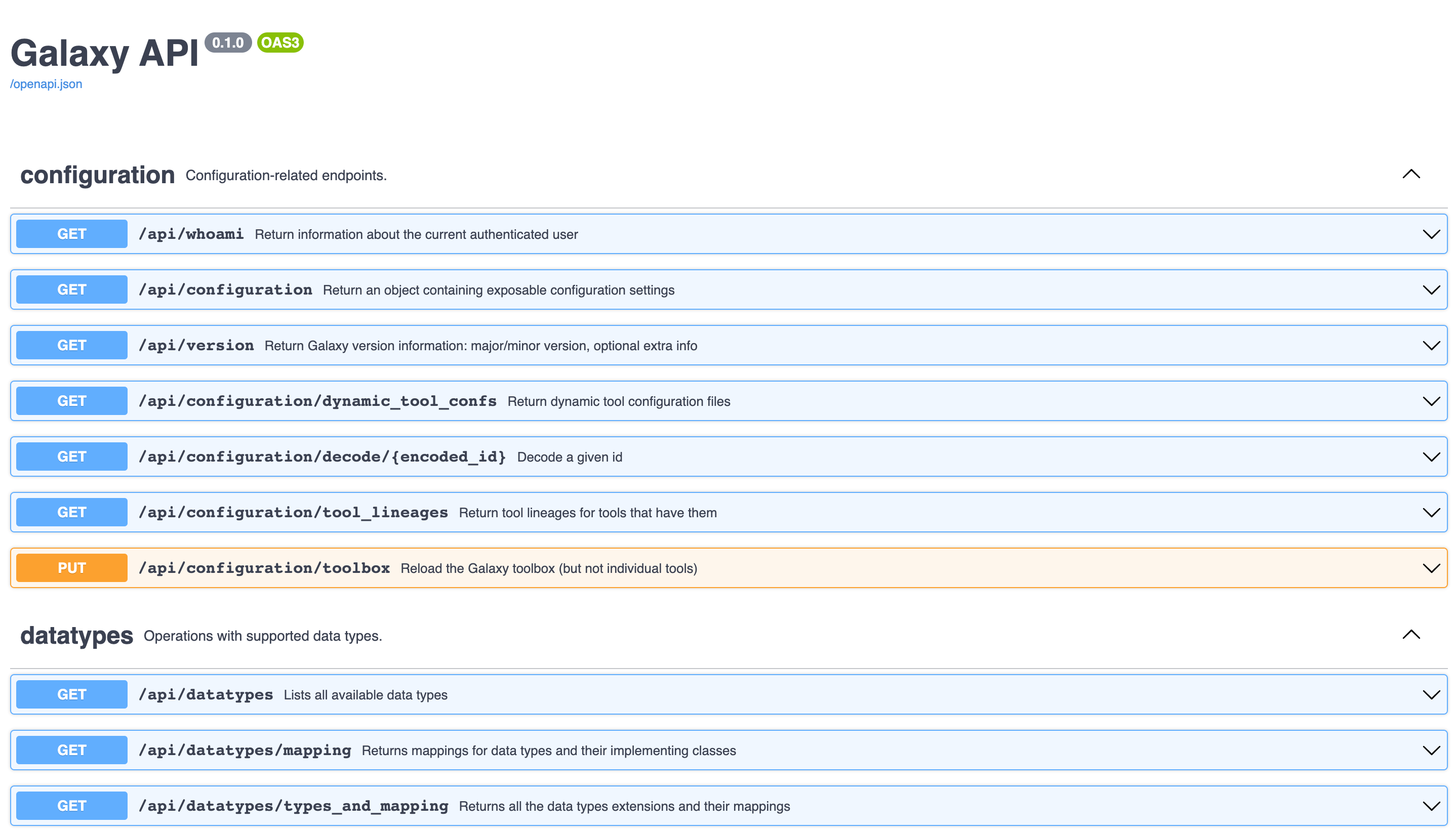
FastAPI and OpenAPI
FastAPI(title="Galaxy API", docs_url="/api/docs", ...)
class: enlarge150
WSGI API Controllers
- Also in
lib/galaxy/webapps/galaxy/controllers/api/ - Mirroring FastAPI controllers until FastAPI required (likely 21.09)
- Exposed method take
transand request parameters and return a JSON response (possibly including Pydantic objects)
class: reduce50
WSGI API Controller Example
lib/galaxy/webapps/galaxy/controllers/api/roles.py
class RoleAPIController(BaseGalaxyAPIController):
    role_manager: RoleManager = depends(RoleManager)

    @web.expose_api
    def index(self, trans: ProvidesUserContext, **kwd):
        """
        GET /api/roles
        Displays a collection (list) of roles.
        """
        roles = self.role_manager.list_displayable_roles(trans)
        return RoleListModel(__root__=[role_to_model(trans, r) for r in roles])

    @web.expose_api
    def show(self, trans: ProvidesUserContext, id: str, **kwd):
        """
        GET /api/roles/{encoded_role_id}
        Displays information about a role.
        """
        role_id = decode_id(self.app, id)
        role = self.role_manager.get(trans, role_id)
        return role_to_model(trans, role)

    @web.expose_api
    @web.require_admin
    def create(self, trans: ProvidesUserContext, payload, **kwd):
        """
        POST /api/roles
        Creates a new role.
        """
        expand_json_keys(payload, ["user_ids", "group_ids"])
        role_definition_model = RoleDefinitionModel(**payload)
        role = self.role_manager.create_role(trans, role_definition_model)
        return role_to_model(trans, role)
class: enlarge150
Legacy WSGI Controllers
lib/galaxy/webapps/galaxy/controllers/- Return arbitrary content - JSON, HTML, etc…
- Render HTML components using mako templates (see
templates/) - The usage of these should continue to decrease over time.
| .footnote[Previous: Galaxy Files and Directory Structure | Next: Dependency Injection in Galaxy] |
Key Points
- FastAPI (ASGI) for new API endpoints
- WSGI for legacy endpoints
- Middleware handles cross-cutting concerns
- Routing maps URLs to controllers
- Three types of controllers: FastAPI, WSGI API, legacy web
Thank you!
This material is the result of a collaborative work. Thanks to the Galaxy Training Network and all the contributors! Tutorial Content is licensed under
Creative Commons Attribution 4.0 International License.
Tutorial Content is licensed under
Creative Commons Attribution 4.0 International License.