Architecture 12 - Galaxy Client Architecture
Contributors

 John Chilton
Questions
How is the Galaxy UI built?
What frontend technologies does Galaxy use?
How do I develop and test the client?
Objectives
Understand the client build process
Learn about Vue.js and Vuex
Navigate the client source code
Run client tests and development servers
layout: introduction_slides topic_name: Galaxy Architecture
Architecture 12 - Galaxy Client Architecture
The architecture of Galaxy’s web user interface.
layout: true left-aligned class: left, middle — layout: true class: center, middle
Client Architecture
The architecture of Galaxy’s web user interface.
Client Directories
- Source JavaScript for the client is in
client/src. - Source stylesheets are in
client/src/style. - “Packed” bundles served by Galaxy stored in
static/distrun.shusesgit diffto try to determine if client needs to be built before starting Galaxy- webpack builds these “compiled” artifacts
Upshot - to develop against the client, modify files in client/ and rebuild with make client before
deployment.
class: normal
Building the Client - Makefile Targets
client: node-deps ## Rebuild all client-side artifacts (for local dev)
  cd client && yarn run build

client-production-maps: node-deps ## Build optimized artifacts with sourcemaps.
  cd client && yarn run build-production-maps

client-watch: node-deps ## Rebuild client on each change.
  cd client && yarn run watch

client-format: node-deps ## Reformat client code
  cd client && yarn run prettier

client-lint: client-eslint client-format-check ## ES lint and check format of client

client-test: node-deps  ## Run JS unit tests
  cd client && yarn run test

client-test-watch: client ## Watch and run all client unit tests on changes
  cd client && yarn run jest-watch

node-deps: ## Install NodeJS and dependencies.
Automatically Reloading During Development
The following command rebuilds the application on each change.
make client-watch
This is still a relatively slow process, an extra client development server can be started that proxies non-client requests to your Galaxy server and selectively reloads only what is needed during active development (hot module replacement or HMR).
make client-dev-server
Make sure to open Galaxy at http://localhost:8081 instead to point at the client proxy.
class: white
class: enlarge150
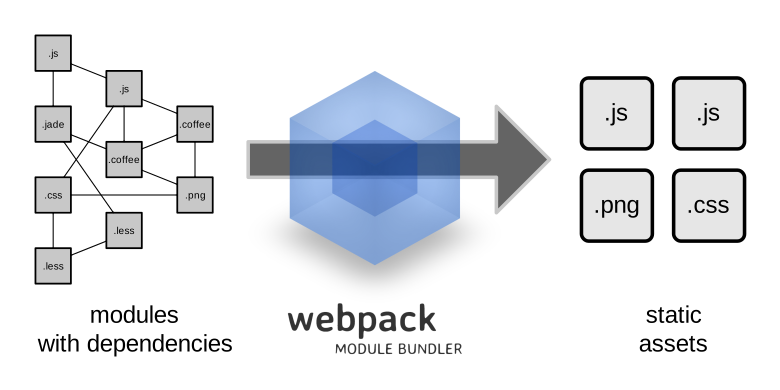
webpack in Galaxy
Packs and “transpiles” Galaxy ES6 code (.js), Galaxy Vue modules (.vue), libraries from npm, scss stylesheets (.scss) into browser native bundles.
Hundreds of high-level well organized files into optimized single files that can be quickly downloaded.
Lots of active development and complexity around Viz plugins and dependencies for instance, but the webpack configuration file in config/webpack.config.js is fairly straightforward.
class: white
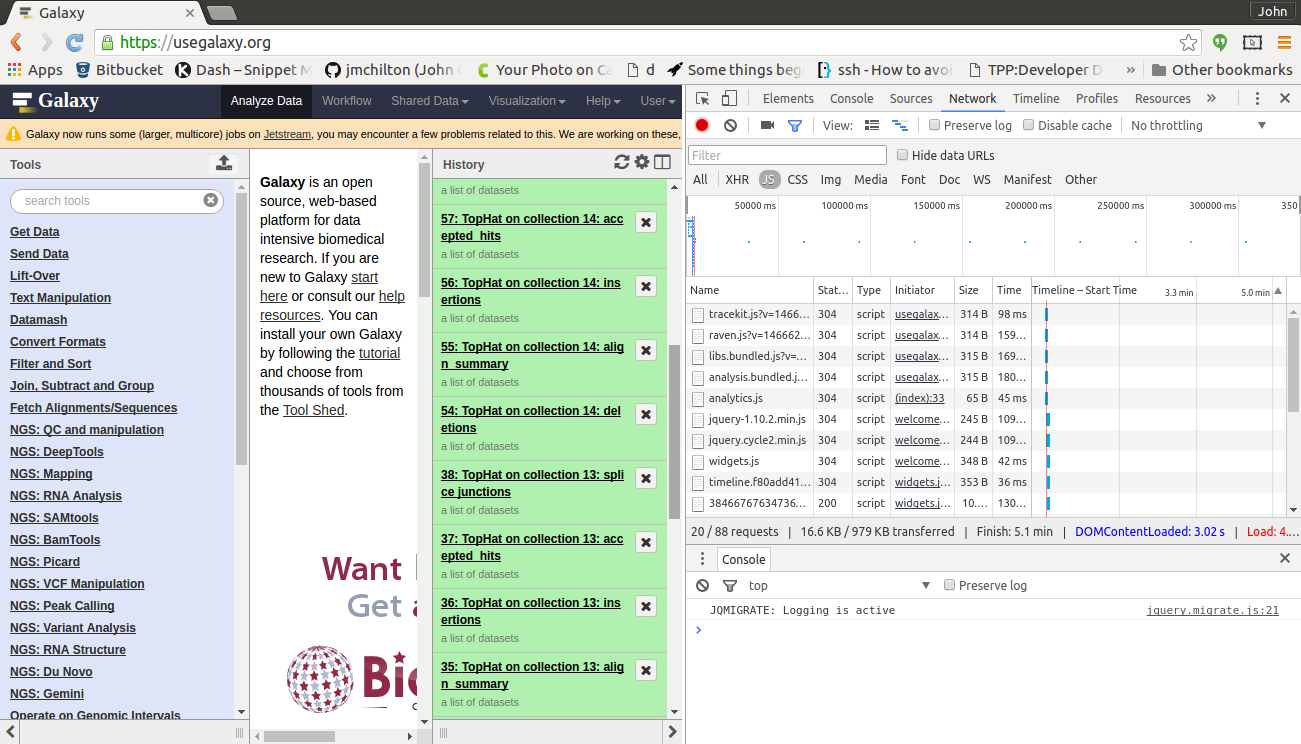
Stylesheets
- Galaxy shared stylesheets are generally defined using the SCSS syntax
- SCSS is a high-level superset of CSS - https://sass-lang.com/documentation/syntax
sassis leveraged by webpack to convert these styles to native CSS at client build time- Rebuild style with
make style - Galaxy’s SCSS files can be found in
client/src/style/scss/
Package and Build Files

Source Files

ES6
The client is built from JavaScript source files. We use ES6 JavaScript.
A tutorial to help learn JavaScript generally might be https://www.w3schools.com/js/.
For someone familiar with JavaScript but that wants a primer on the new language features in ES6, https://www.w3schools.com/js/js_es6.asp may be more appropriate.
Vue
Vue.js is a reactive framework for building web client applications.
We chose Vue.js over React initially because of its focus on allowing developers to incrementally or progressively replace pieces of complex existing applications.
The idea behind Vue.js is fairly simple to pick up and there is a lot of great tutorials and videos available. https://vuejs.org/v2/guide/ is a really good jumping off point.
Pinia
Pinia is a state management library for Vue.js. It provides stores as the central source of truth, with a simpler, more intuitive API compared to earlier solutions. It supports Vue 2 and Vue 3 with Composition API.
https://pinia.vuejs.org/
Key features include devtools integration, hot module replacement, type-safe stores, and seamless TypeScript support.
Client Unit Tests
https://jestjs.io/
Configured in client/src/jest/jest.config.js.
Vue tests are placed beside components in client/src, more tests in client/test/qunit/tests and client/test/jest/standalone/.
Vue Test Utils
Vue Test Utils is the official unit testing utility library for Vue.js.
https://vue-test-utils.vuejs.org/
Really nice reference library documentation. A lot of helpers and concepts to unit test Vue components.
Client Unit Test Design Tips
https://github.com/galaxyproject/galaxy/tree/dev/client/docs/src/component-design/unit-testing
- Clearly document the intent of your test
- Implement logic in pure functions when possible
- Wrap native browser resources in a function so they can be easily mocked
Webhooks in Galaxy
Webhooks is a system in Galaxy which can be used to write small JS and/or Python functions to change predefined locations in the Galaxy client.
In short: A plugin infrastructure for the Galaxy UI
.footnote[You can learn more about webhooks using our webhook training.]
Webhook masthead example
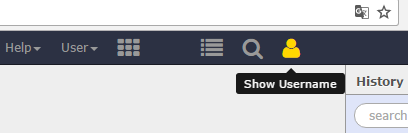
At the header menu: Enabling the overlay search, link to communities …
.footnote[You can learn more about webhooks using our webhook training.]
Webhook tool/workflow example
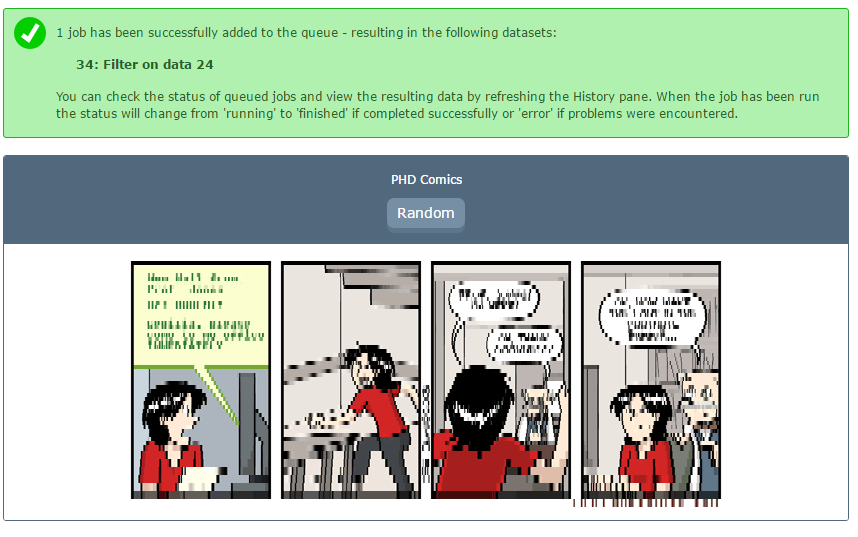
Shown after tool or workflow execution. Comics, citations, support …
.footnote[You can learn more about webhooks using our webhook training.]
Webhook history-menu example
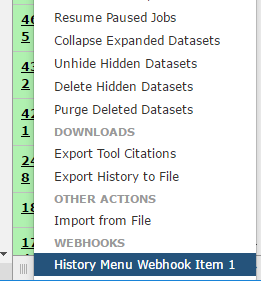
Adds an entry to the history menu - no functionality as of now
class: enlarge150
Galaxy Component Library
Galaxy is replacing Bootstrap-Vue with custom components:
- Reduce dependency - Prepare for framework upgrades
- Improve consistency - Unified design language
- Enhance accessibility - Built-in a11y
- Simplify maintenance - Galaxy-specific needs
class: enlarge120
Deprecated BootstrapVue Components
Do not use these in new code:
| BootstrapVue | Use Instead |
|---|---|
BButton, b-button |
GButton |
BLink, b-link |
GLink |
BModal, b-modal |
GModal |
BCard, b-card |
GCard |
Existing usages should be migrated when touching related code.
class: enlarge150
Component Migration Effort
Migration strategy:
- New code - Always use Galaxy components
- Modified code - Migrate when touching files
- Batch migrations - Periodic focused efforts
Reference PRs:
class: enlarge150
Component Library Patterns
- Polymorphic - Same API for button, anchor, router-link
- Integrated tooltips - Built-in via
title+tooltipprops - Semantic colors -
blue,red,greennot Bootstrap variants - Composable internals - Shared logic in composables
class: enlarge150
Creating a Component Wrapper
Follow established patterns:
- Use
ComponentColorandComponentSizetypes - Integrate tooltips via
title/tooltipprops - Use shared composables for common logic
- Apply CSS custom properties for theming
- Include ARIA attributes for accessibility
See existing components in client/src/components/BaseComponents/
class: enlarge150
Future Component Work
Likely next components based on Bootstrap-Vue usage:
- GAlert - Notification banners
- GDropdown - Dropdown menus
- GTable - Data tables with sorting
- GTabs - Tab navigation
- GCollapse - Collapsible sections
| .footnote[Previous: Galaxy Markdown Architecture | Next: Galaxy Dependencies Management] |
Key Points
- Source in `client/src`, built bundles in `static/dist`
- Webpack handles bundling and transpilation
- Vue.js for reactive components
- ES6 JavaScript
- Jest for unit testing
- Webhooks for UI plugins
Thank you!
This material is the result of a collaborative work. Thanks to the Galaxy Training Network and all the contributors! Tutorial Content is licensed under
Creative Commons Attribution 4.0 International License.
Tutorial Content is licensed under
Creative Commons Attribution 4.0 International License.